Traditional vs Modern Digital Marketing: What Every Bangladesh Business Owner Needs to Know
A garment factory owner in Gazipur asked me last year why she was spending 40,000 taka a month on newspaper ads and still losing clients to a competitor half her size. The competitor posted three Facebook videos a month and ran a WhatsApp broadcast list. No newspaper. No billboard. She had more brand recognition and a smaller inbox. That gap is the whole traditional vs digital marketing conversation, and it plays out every week inside Bangladeshi businesses.
Neither channel is dead. Neither is automatically right. But the math and the behavior have shifted enough in the last five years that picking the wrong one for your stage and budget will cost you real customers.
What traditional marketing actually means
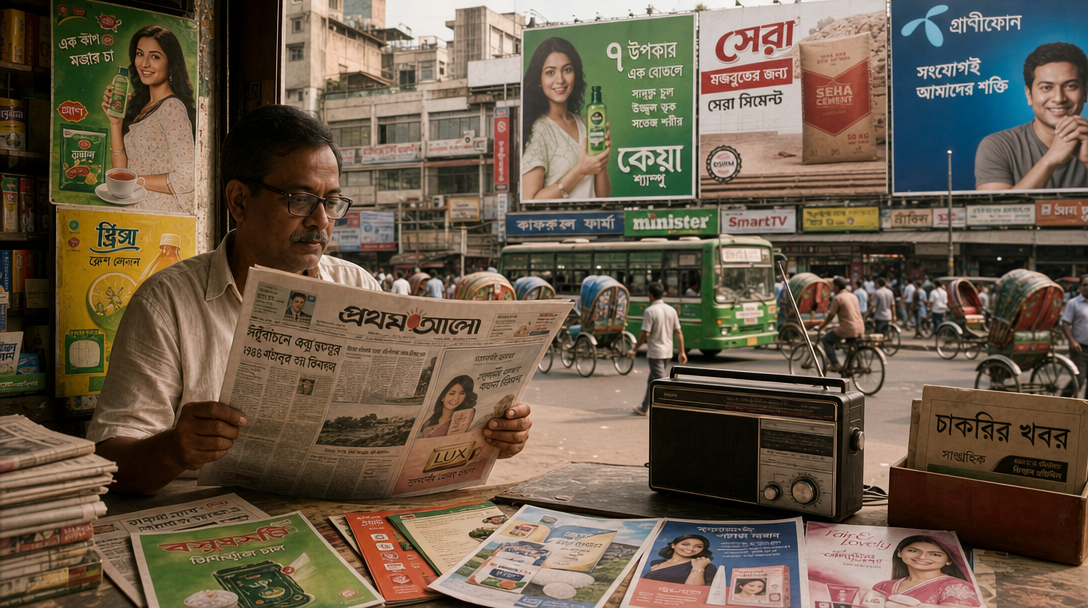
Traditional marketing is anything that reaches an audience offline: newspaper and magazine print ads, TV and radio commercials, billboards and hoardings, leaflets, brochures, and banner stands at trade fairs. In Bangladesh, this channel still carries weight in specific situations.
A Prothom Alo or Daily Star print ad reaches educated, older readers who still trust what they read in paper. A hoarding on the Tejgaon flyover gets seen by hundreds of thousands of commuters every day. A radio spot on ABC Radio or Radio Foorti during morning drive time hits people already in a buying mindset because they are heading to work with money in their pocket.
The reason traditional marketing built companies for decades is simple: it reaches people passively. You do not need the consumer to search for you. The billboard is there whether they want it or not. That passive reach has real value when you are launching a new brand nobody knows yet, especially one targeting older, less digitally active demographics.
Here is the honest gripe though. Traditional channels tell you almost nothing after you spend the money. You run a newspaper ad for 15,000 taka and you genuinely cannot tell whether three customers or three hundred customers saw it and walked through your door because of it. You are buying reach and hoping, not measuring and adjusting.
What traditional marketing costs in Bangladesh
- Half-page Prothom Alo print ad: 40,000 to 1,20,000 taka
- 30-second radio spot (ABC/Foorti): 3,000 to 8,000 taka per airing
- Roadside hoarding, prime Dhaka location: 80,000 to 3,00,000 taka per month
- Leaflet printing and distribution (10,000 copies): 8,000 to 15,000 taka
- Trade fair stall and banner: 20,000 to 60,000 taka per event
What digital marketing actually delivers
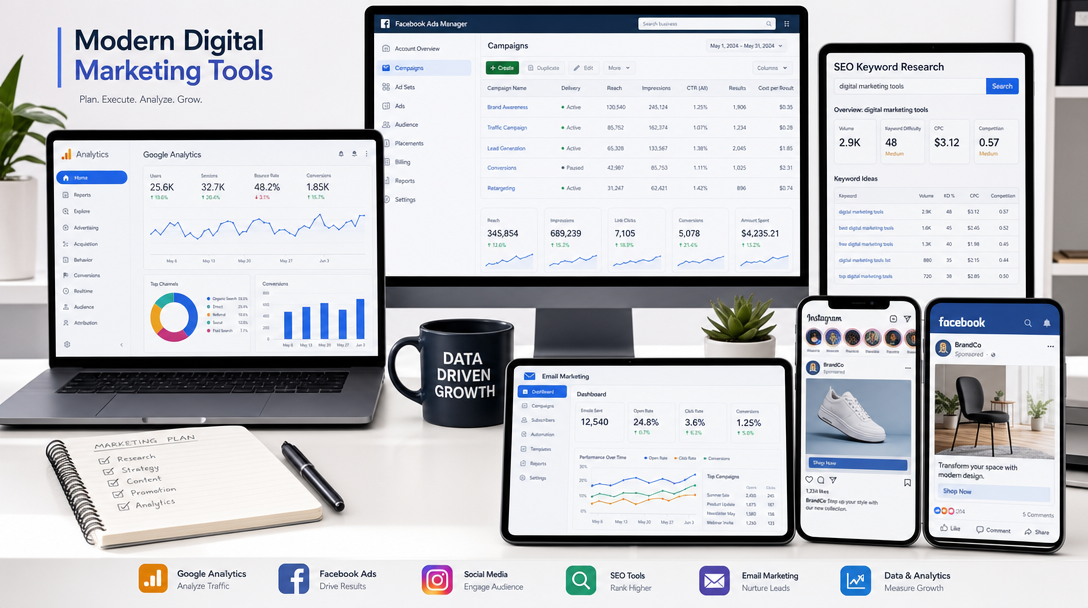
Digital marketing is any channel that runs online: search engine optimization (SEO), Google Ads, Facebook and Instagram advertising, content marketing, email marketing, WhatsApp broadcasts, YouTube videos, and influencer partnerships. Most Bangladesh business owners already dabble in Facebook. Far fewer do the full picture.
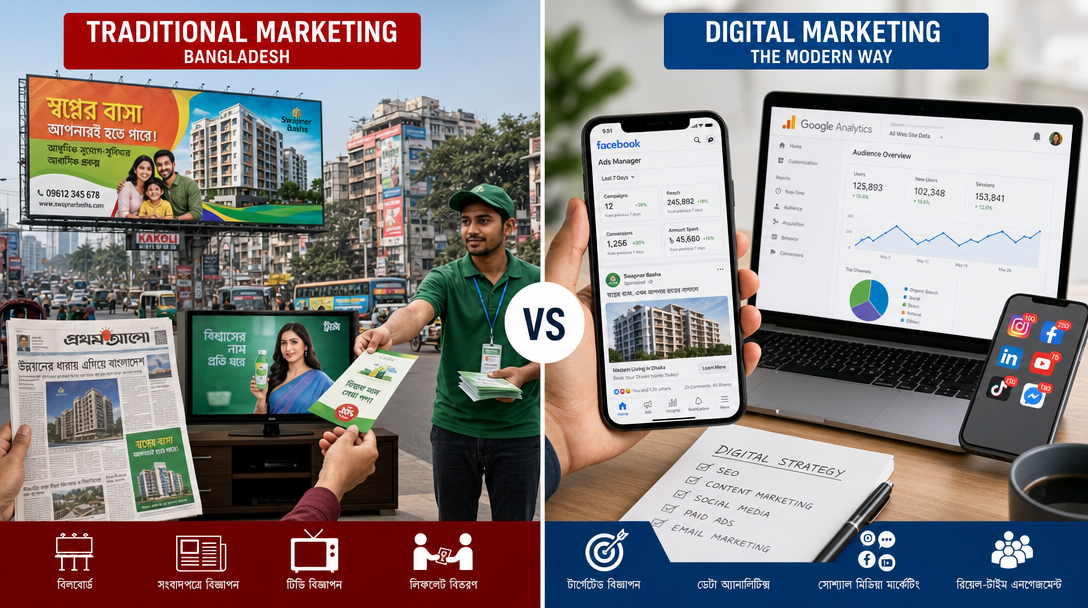
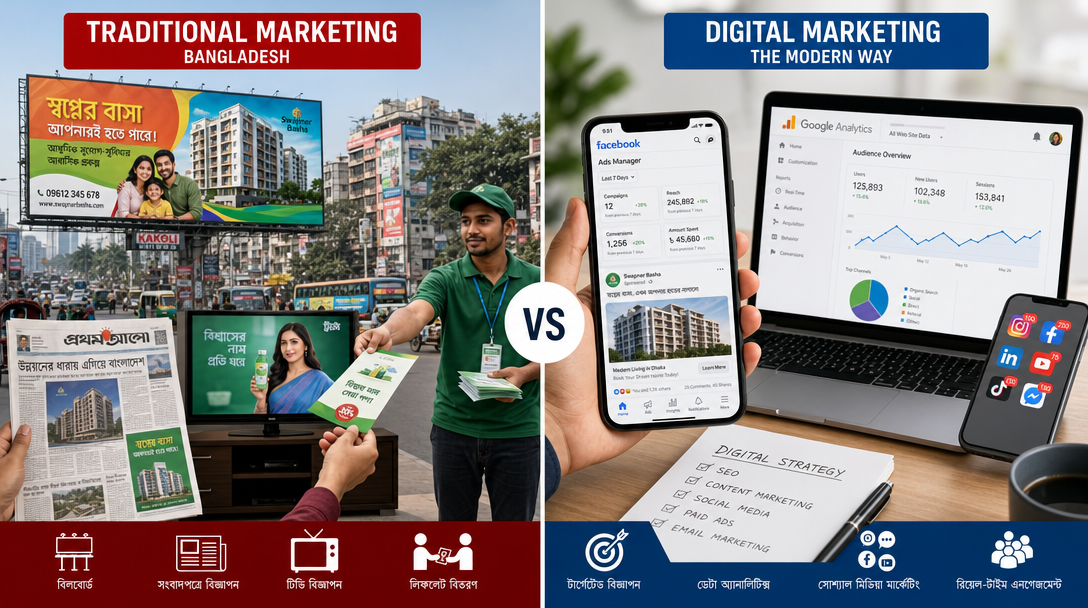
The fundamental difference from traditional is targeting. A newspaper ad goes to everyone who buys that paper. A Facebook ad goes to women aged 22 to 35 in Dhaka who have shown interest in beauty products and engage with fashion pages. One costs ten times more and hits ten times fewer of the people who will actually buy from you.
The second difference is measurement. You open Ads Manager and you see exactly how many people saw the ad, clicked it, sent a message, and completed a purchase. When a campaign fails, you know inside 48 hours. When one works, you scale the budget in 10 minutes. No newspaper lets you do that.
What digital marketing costs in Bangladesh
- Facebook/Instagram ad campaign: 150 to 1,000 taka per day, your control
- Google Ads (search): 5 to 50 taka per click depending on competition
- SEO monthly retainer (agency): 8,000 to 30,000 taka per month
- Email marketing tool (Mailchimp free tier): 0 taka up to 500 contacts
- Content creation (one blog post, local freelancer): 800 to 3,000 taka
- Influencer post (micro-influencer, 10k to 50k followers BD): 2,000 to 15,000 taka
The Bangladesh market: where your customers actually are
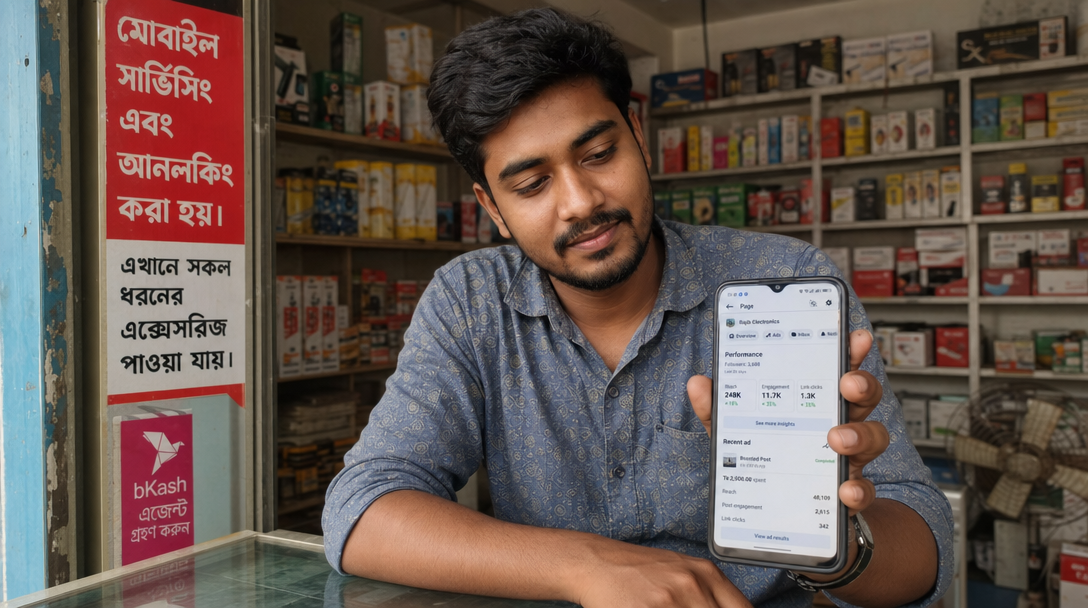
Bangladesh has roughly 125 million internet users, and more than 90 percent of them access it through a phone. Facebook has over 50 million active users here. YouTube comes second. TikTok has exploded among under-30 buyers.
But this same audience watches BTV and private channels during Iftar. They read the paper with morning tea. They notice the hoarding on the road to Friday prayers.
What the data actually shows is that the vast majority of your customers use both worlds. They see a billboard for a clothing brand and then check the brand’s Facebook page before they buy. They read a newspaper article about a product and then Google the price. The research-to-purchase journey almost always crosses both channels, even when the final click happens online.
For a Dhaka restaurant: digital wins almost every time. Your customers are phone-first, they search Google Maps before they leave the house, and a Facebook video of your food converts directly into a reservation. A newspaper ad for a restaurant is an expensive reminder that nobody acts on immediately.
For a garment exporter: a mix wins. Buyers abroad find you through LinkedIn and trade fair presence. Local brand visibility through a newspaper business supplement still carries credibility in the B2B space in a way a Facebook post does not, especially for government and institutional buyers.
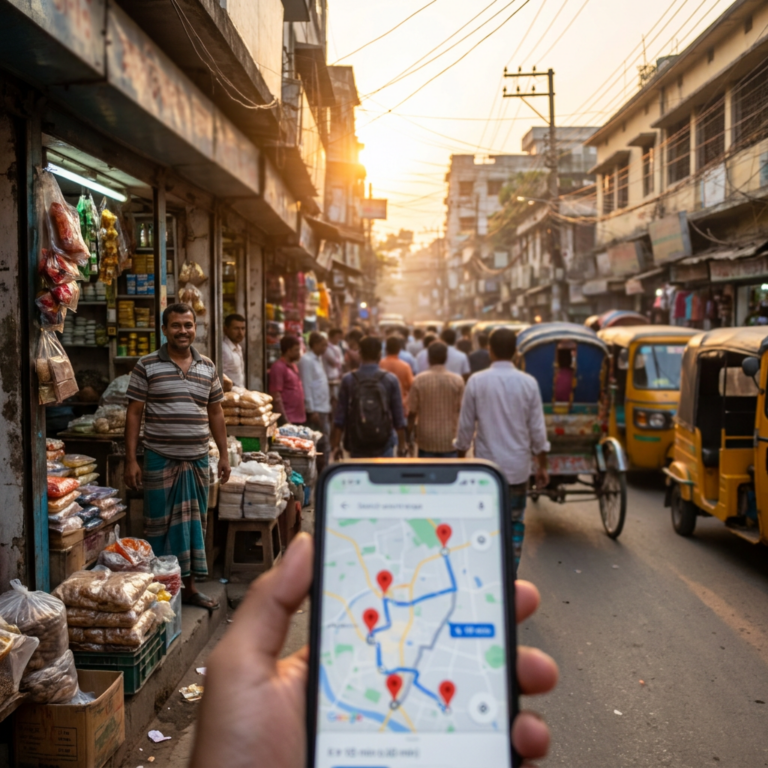
For a pharmacy chain: local SEO and Google Maps dominate. Someone three streets away needs paracetamol at 11pm. They will not remember a billboard. They will Google “pharmacy near me” and call the first one that answers.
Cost vs reach: the comparison that changes the conversation
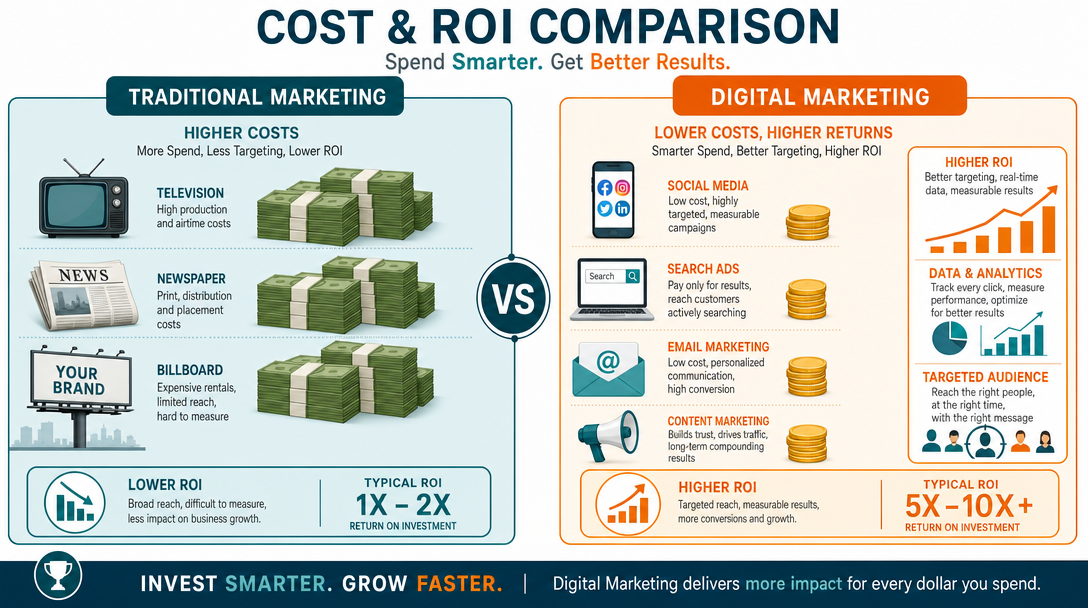
Let us put real numbers side by side for a small Dhaka business with a 30,000 taka monthly marketing budget.
Traditional: 30,000 taka
- One quarter-page newspaper ad (15,000 taka) reaching perhaps 100,000 readers
- One batch of 5,000 leaflets distributed around the neighborhood (8,000 taka)
- One radio mention in a local shop broadcast deal (7,000 taka)
- Estimated new customers directly traceable: unclear, probably 0 to 10
Digital: 30,000 taka
- Facebook/Instagram ads targeting Dhaka buyers: 300 taka per day for 30 days (9,000 taka), reaching 15,000 to 40,000 targeted people per day
- One SEO-optimized blog post and social content: 3,000 taka
- WhatsApp broadcast to existing customer list: 0 taka
- Google Business Profile updates and posts: 0 taka
- Remaining 18,000 taka for scaling the ad that worked
- Estimated new customers directly traceable: 20 to 80 with a decent offer
I assumed clients who had run traditional marketing for years would push back hard on this comparison. Most of them did not, once they saw their own ad spend next to actual cost-per-customer numbers. The newspaper ad that felt important cost 3,000 taka per new customer. The Facebook campaign cost 400 taka per new customer. That is not a marginal difference.
The exception is brand building at scale. A large company spending 10 lakh on a TV campaign is buying something Facebook cannot fully replicate: mass simultaneous awareness. If every person in Bangladesh needs to know your name by Eid, TV and radio still reach more people faster. That matters for FMCGs and telecom companies. It rarely matters for the shop on Road 7, Banani.
The hybrid approach that actually works
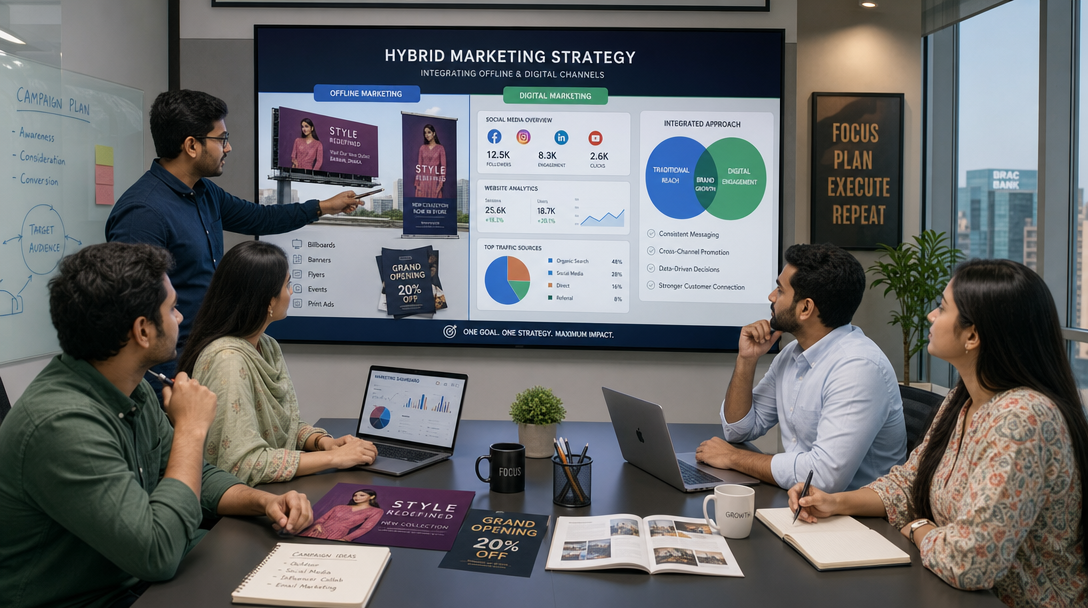
The businesses growing fastest in Bangladesh right now are not choosing one or the other. They run a light traditional presence to build credibility and awareness, and they run digital as the primary driver of trackable revenue.
Here is the specific mix I recommend for a small-to-medium BD service or product business with a budget under 1 lakh per month:
Digital (70% of budget)
- Facebook/Instagram ads as primary acquisition channel
- Google Business Profile and local SEO for search visibility
- WhatsApp broadcast to your buyer list every two weeks
- One blog post per week repurposed into social content
Traditional (30% of budget)
- One newspaper mention or advertorial per quarter for credibility signaling
- Leaflets at the physical locations where your buyers gather (trade fairs, events, shopping centers)
- Signboard and shop front investment, since local foot traffic still exists
The reason this ratio works: digital gives you the data to optimize, and traditional gives you the offline credibility signal that online-only brands often lack. A buyer who sees your Facebook ad and then sees your name in the newspaper feels less like they are sending bKash to a stranger.
The biggest mistake is doing it the other way around: 70% on traditional for credibility, 30% on digital hoping for sales. That is 2010 logic applied to a 2026 market.
FAQ
Is traditional marketing dead in Bangladesh?
Not dead, but repositioned. For mass-market FMCG brands, elections, and large institutional campaigns, print and broadcast still reach audiences digital cannot. For most small and medium businesses selling to phone-first customers, traditional should be a credibility supplement, not the primary spend.
Which digital channel works best for new businesses in Bangladesh?
Facebook and Instagram are the fastest path to first customers because the targeting is precise and the entry cost is low. Pair them with a Google Business Profile so customers who search your category find you on the map. SEO and content marketing come in once you need free traffic at scale, but they take three to six months to show up.
How do I measure whether my traditional marketing is working?
The simplest method: ask every new customer how they found you and record the answer in a notebook or spreadsheet. Add a unique phone number or promo code to each traditional placement. At the end of the month you will see which channel generates actual conversations, not impressions.
Should a small Bangladeshi business spend on TV ads?
Almost never at the small business stage. A 30-second prime-time spot on a national channel costs 50,000 to 2,00,000 taka for a single airing. That budget runs a targeted Facebook campaign for two months with full performance data. The only exception is hyperlocal cable channels in specific districts, where a 30-second slot runs 1,000 to 3,000 taka and your audience is literally in the same neighborhood as your shop.
What is the right total marketing budget for a small BD business?
A common benchmark is 5 to 10 percent of monthly revenue. A shop turning 2 lakh taka a month should spend 10,000 to 20,000 taka on marketing. At that level, digital-only (Facebook, Google, WhatsApp) is almost always the right call because the measurement payoff matters more when the budget is tight.